

Suicidal Psychopathy
Move over, Gays for Palestine. The Surfers for Sharks are here!

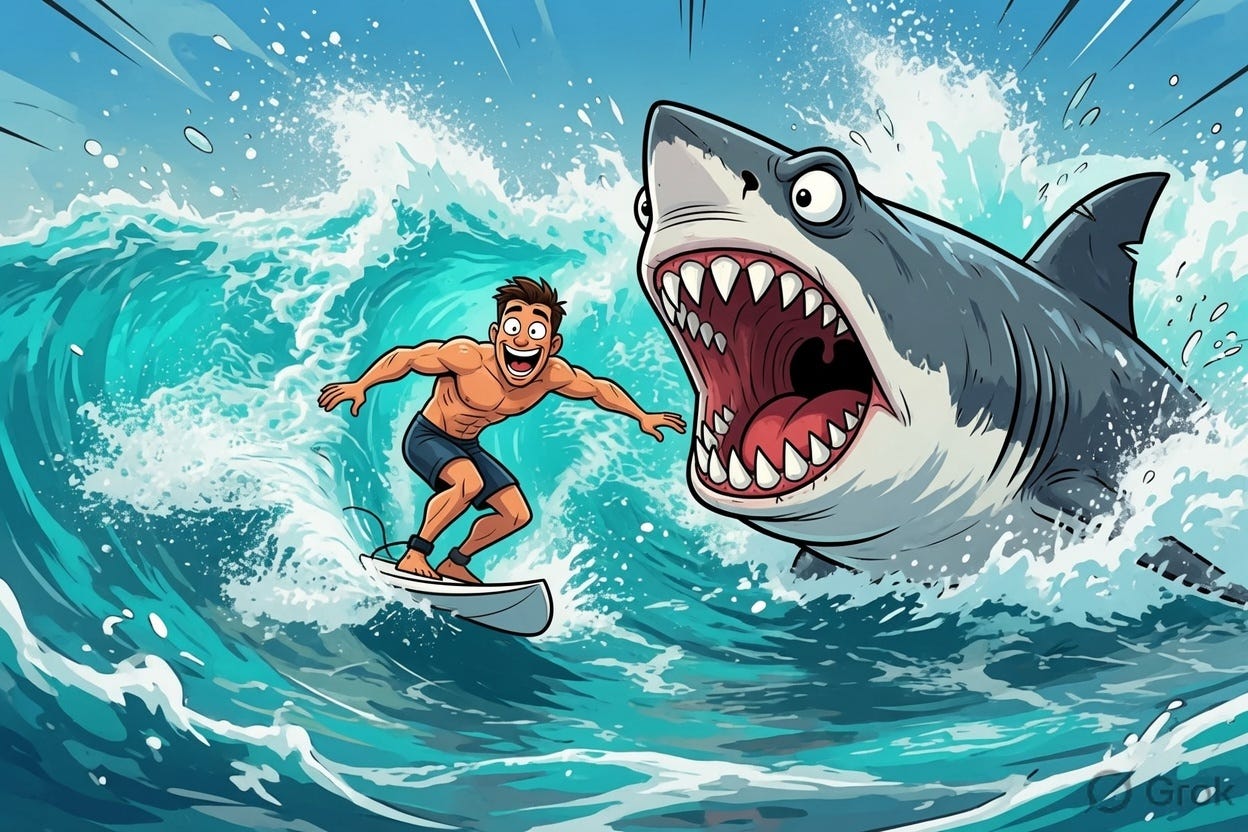
If the Gays for Palestine who were run over by a fellow pro-Palestinian at the Pride march in Berlin on the weekend suffer from what Canadian evolutionary psychologist Gad Saad calls “suicidal empathy”, what do surfers who love sharks suffer from?
At first glance, the two psychological conditions seem identical: mental disorders that compel their sufferers to revere whatever is their most mortal threat.
With gays, it’s Muslims, and they take their devotion to these avowed persecutors very seriously indeed. The blood-splattered remains of the latest gay-homicide victim had not even been scraped off the Berlin bitumen, and the dozens of seriously injured had barely been loaded into ambulances, before other gays from the march took to social media to say how sad they were that the name of the driver was, yet again, Abdul and not, say, Karl or Hans.
This is textbook suicidal empathy. But it at least has a tiny sliver of rationality about it. It’s a long shot, I know, but there is a chance that if the gays continue to show passive compassion towards their Muslim predators, then one day the Muslims will realise that driving cars through Pride marches or throwing effeminate men off tall buildings isn’t all it’s cracked up to be, and maybe, just maybe, living peacefully alongside other people is an altogether more pleasant and mutually beneficial way of spending one’s time on Earth.
But even this infinitesimally tiny hope is greater than anything surfers can expect from their widespread, newfound reverence for man-eating sharks. Whatever deference they show for these marine predators will only ever be one way. This is worse than suicidal empathy; it’s suicidal psychopathy – a reverence for sharks based on a psychopathic dislike of humanity.
It was quite coincidental that as Abdul was ploughing through the Pride march on Saturday, I was fending off online attacks from surfers for having had the temerity to suggest that killing sharks to make beaches safer was a good idea.
Allow me for a minute to fill in the background to how this came about.
In the mid 2000s, a new surf magazine was established by friends of mine in Bondi, called Stab. Their conscious intention was to lob hand-grenades into what had then become surfing’s relatively dull, commercial and conformist subculture.
I contributed a bunch of stories that fitted that mould, two of which stood out.
The first was the profile of Matt Branson, a hard-living punk pro surfer from the 1980s and 90s who in his youth used to join his friends bashing the men hanging around known gay haunts in his home town of Perth; Branson later had to drop off the tour to come out as gay himself. Stab was just a few editions old at the time but he clearly liked what he saw. I cold-called him at his home on the Gold Coast, he agreed to discuss everything, and I was on the next flight up there. The ensuing story was nominated for a prestigious prize. Branson has not spoken to another journalist since.
The other was even more sensational. It was about Paul Sargeant, the most prolific photo-journalist in surf publishing history, whose habit of molesting young men on tour, often after they’d passed out on drugs and alcohol, was well known among the sport’s inner sanctum, including journalists, all of whom studiously ignored it as a story.
I spent months digging into Sargeant’s past, and wrote about 7000 words detailing both his sordid escapades and his selfless support for kids trying to make it on tour, a common characteristic of sexual predators. The readers were shocked and enthralled. For years afterwards, strangers I met who realised I was the story’s author flatteringly complimented me on it.
The only people who disliked the story were the handful of Sargeant’s remaining friends and the journalists who had wilfully declined to investigate it themselves, and who now looked a tad dodgy. One of them was a journalist called Tim Baker, who I learned on the weekend has never forgiven me for it.
My career went in different directions after that, and I didn’t have much to do with Stab until a few weeks ago, when its editor asked me if I’d like to participate in a video debate about how to solve the increasingly lethal shark problem at Australia’s beaches.
I jumped at the chance. Eleven years ago, I noticed that surfers were being increasingly attacked by sharks. I started to investigate what was going on, found an abundance of dubious scientific research that was indirectly causing these attacks, and wrote about it frequently in The Australian. To my dismay, surf magazines were showing as much interest in this as they had in Sargeant’s previous sexual assaults, which I thought was strange. These animals were eating their readers! How could that not be a compelling topic?
On the weekend, the reason for their reticence became blindingly clear. Stab’s readership today is vastly different to the one that existed 18 years ago.
The debate wound up being, by most standards, a mild affair. My opponent, Wollongong social scientist Michael Mehmet, argued for mitigation strategies that incorporate as many non-lethal methods as possible; I argued, correctly in my opinion, that the cheapest and most effective way of deterring sharks from our beaches is a lethal one: nets. Invented in Sydney in 1937, nets have an almost impeccable record of saving lives in both Australia and South Africa. Mehmet and I locked horns a few times, but in the end there was no acrimony.
None of my informed opinion, however, could penetrate the mindset of many of Stab’s new generation of readers. Rather than digest the conclusions of a journalist who had been writing about the topic for 11 years, many of them responded with furious, censorious indignation.
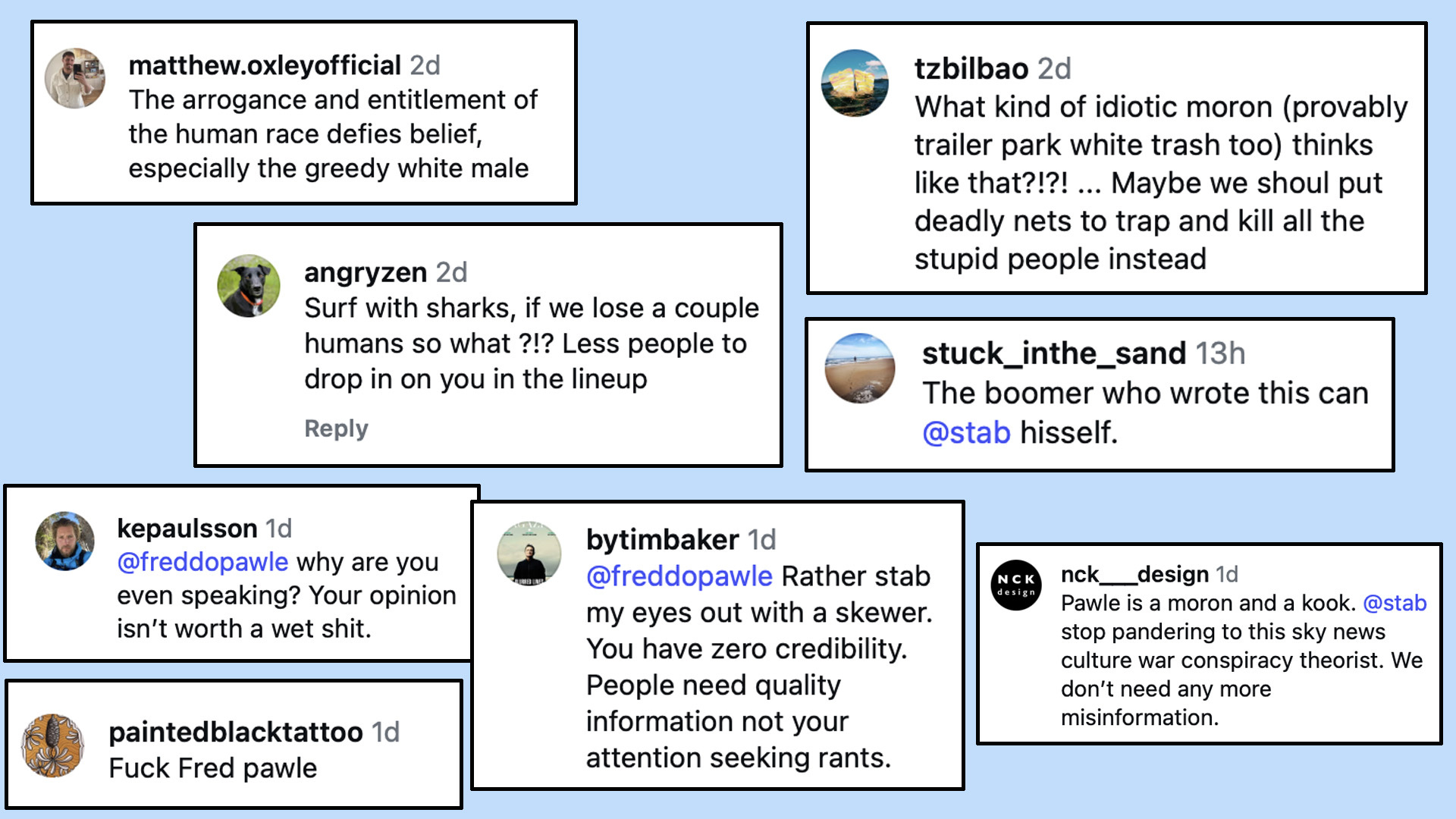
Baker enthusiastically trolled among the comments, calling me a grifter and a hack who had no authority to engage an “expert” in debate. In an ironic twist that even Shakespeare would have thought implausible, he admitted to not having watched the debate but criticised it anyway because I’m too uninformed.
The vitriol can be shrugged off, but the broader context is disturbing. Great white sharks were granted protection in Australia in 2000 for what I have discovered were dubious reasons. More than 60 people have been killed by sharks since then, and scores more seriously injured. I have argued repeatedly that the protection should be lifted. Frustrated that politicians were ignoring me, I produced, wrote, presented and financed a documentary last year, The Heart of Sharkness, and posted it to YouTube, hoping it might finally convince Canberra that the carnage had gone on too long, and was worsening. It didn’t work, and I lost maybe $50,000 in the process.
Whatever. The financial loss doesn’t bother me. But the fact that some surfers found this so objectionable does. Disagree with me if you like, but doesn’t my objective, to save human lives, count for anything?
So what changed in Stab’s readership since the days when the magazine was boldly blowing up the culture and exposing scandals?
The only explanation I can offer is that most of the current generation of readers were brainwashed by the education system. The environmentalism that is preached in classrooms these days convinces children that nature is sacrosanct, and all human activity is unambiguously destructive.
This has two complementary effects. First, it limits the kids’ employment prospects. Their university degrees are invariably useless, and their incurious self-assuredness often makes them impossible as employees anyway. Even the ones who do manage to get decent jobs are unlikely to ever afford a house in which to raise a family, thanks to their generation being screwed over by boomers and compulsory superannuation.
But this doesn’t bother them because, on the flip side, environmentalism also comes complete with a smug sanctimony that conveniently assuages most of life’s other disappointments.
Acquire the correct environmental credentials, and you suddenly become more virtuous than people who are richer, more successful and even happier than you are. Pretty soon it grows into the equivalent of a religious devotion, and anybody who dares to blaspheme against it is instantly cast as greedy and privileged, especially if he’s white. In the end, it leads mostly to misanthropy and misery.
No wonder they’re so angry.
Dear reader, if you appreciate this piece, please share it as widely as possible, and consider becoming a free or paid subscriber to my Substack page. Your support enables me to produce more content in defence of what’s left of our amazing country.
You can also Buy Me A Coffee here.
If you want to learn about the tragic human cost of protecting sharks in Australia, watch my entertaining and enlightening documentary, The Heart of Sharkness, here.
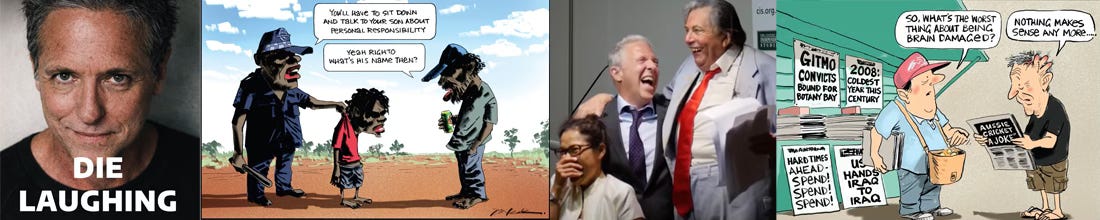
I’ve also recently published a new edition of Die Laughing: The Wild Life of Bill Leak. Bill was widely mocked for warning 10 years ago that political correctness would destroy Australia’s awesome culture. Well, who’s laughing now? You can buy the new edition here.
You're right, they're angry. I had the opportunity to have The Shark Debate conversation with the Mother of one of my students. It didn't go well. She became visibly shaken, and indignant when i suggested sharks were inferior to humans and there were far too many of them. The indoctrination runs deep.
Maybe things are turning around in this next generation. My 18 year old son and his friends all Cronulla surfers are not woke shark huggers. They all agree the sharks should be pushed back from our beaches. And from my perspective, I think people have lost sight of the sanctity of human life. We are above the animals and are called to be good stewards of God’s creation. And if we ‘are’ animals, how is us protecting ourselves from predators any different from any other animal doing the same?