

The Culling Feels
Propose to reduce the population of a dangerous animal, and watch environmentalists go hysterical.

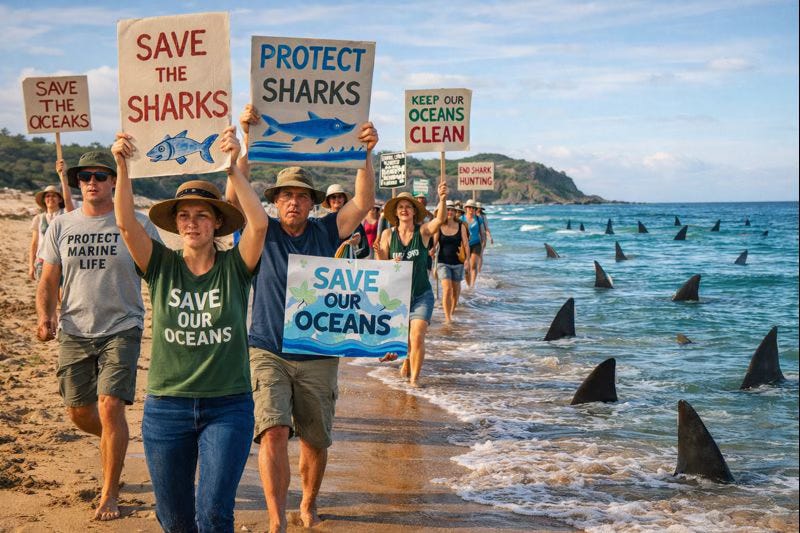
Keeping people safe from dangerous animals was once considered an admirable, even noble thing to do.
When Man Eaters of Kumaon, a collection of 10 short non-fiction stories about hunting and killing rogue tigers and leopards that were terrorising remote Indian villages by English hunter Jim Corbett, was published in 1944, it quickly became an international bestseller, shifting 4 million copies.
Its charm was twofold. A white man risks his own life to eradicate a mortal threat for less sophisticated people, earning their eternal gratitude and affection, and bridging cultural divides. And he does it using lethal technology, in this case a rifle.
I don’t need to remind modern readers that almost everything about Corbett’s stories is despised in these more environmentally zealous times, not least of which is the assumption that humans have the right to dispatch dangerous animals at all.
Environmentalists often claim to use science as their guide in such issues, but their response to anybody who still dares to advocate the traditional Corbett style of predatory-animal management are both emotional and irrational.
I’ve lost count of the number of times I’ve been accused of wanting to “kill all the sharks” after every time I’ve proposed a shark cull in the 11 years since I started writing about this subject.
Perhaps it’s because “cull” sounds so much like “kill”, and hysterical environmentalists confuse the two in their rush to express their indignation under my stories and social media posts.
They are doing the same now in response to the culling of dingoes on Fraser Island (K’Gali) and the proposed culling of crocodiles in Queensland.
The ABC reports that the traditional owners of Fraser Island are “heartbroken” about the dingoes that were found surrounding the body of a tourist on a beach, who had previously drowned, being arbitrarily culled.
The traditional owners might have a point that the dogs were not responsible for the tourist’s death, but their affection for such wild, aggressive animals, and their insistence that they, the traditional owners, must be consulted before anyone else acts to make the island safer for humans, neatly represents our society’s inverted values and deference to emotional, irrational opinion when it comes the environment.
The ABC’s report of the culling is, curiously, the exact opposite of the stories Corbett made so popular last century.
There are estimated to be more than 100,000 saltwater crocodiles in Australia, and they are an increasingly menacing presence across the Top End. Given that, an end to protection would seem to make sense, as would a well-managed cull.
But a cull proposed by Katter’s Australia Party in Queensland last year was defeated by a state parliamentary committee, and protection remains in place. It is inevitable that the casualty rate from crocs will soon increase the way the toll from sharks has in recent years.
Scientists resist the simplicity of a cull, insisting instead that more complex methods that can preserve predators and humans alike, are both possible and desirable.
The NSW shark-management strategy is proof that this is pathologically deluded.
The state has one of the biggest shark-tagging operations in the world, and has placed devices that detect tagged sharks off 37 beaches in the state. A report commissioned by the NSW Department of Primary Industries from global professional services company Cardno in 2022 found that these devices were more or less useless.
Comparing the rate of shark encounters before and after the devices were deployed, the authors of the report concluded, in the diplomatic language of academia, that the devices’ usefulness was “not apparent”. In some cases, the rate of encounters actually increased.
The report failed to spark a rethink of the strategy, however, and people are still being attacked. A spate of four attacks in less than two days this month, one of them an unbearably tragic fatal attack on a 12-year-old boy who had jumped from a dive rock into Sydney Harbour as thousands of kids had done before, proves that whatever the DPI is doing, it’s wrong.
The only thing the DPI is good at is creating jobs for callous opportunists.
One of the misconceptions that has arisen since Corbett’s time is that there is something primal about wanting to kill dangerous animals. This was incorrect in Corbett’s time, and is incorrect now.
The tiger is a “large-hearted gentleman with boundless courage”, Corbett wrote in Man Eaters of Kumaon. He warned that if the tigers were hunted to extinction, “India will be the poorer by having lost the finest of her fauna”.
Corbett’s admiration for his adversary is understandable, given that he was often staring them down as they charged towards him. Even then they can be graceful animals.
I doubt I could ever feel the same way towards sharks. Great whites especially look grimly evil to me. I’ve often called them animals with more teeth than brains, and can’t imagine perceiving them any other way.
But my reaction to them still isn’t emotional. I just want to discourage them from coming near humans, which until recently we did with lethal effectiveness.
Call it a cull if you must. I call it saving human lives. It’s strange to have to say it, but a human’s life should always more valuable than any shark, dingo or crocodile.
(This story was originally published in The Australian on 28 January 2026)
For more, watch my documentary, The Heart of Sharkness.
To help me produce more content like this in defence of our awesome country and culture, please consider Buying Me a Coffee, or becoming a free or paid subscriber on Substack.
Hey Fred hope u are well. Another good article also fun to read. Yep “world’s gone mad”. I think the shark mitigation should be taken out of the hands of the gov. They have too many political anchors beholding to their always desperate ambitions to hold power. Greens, other factions / its goes on and on. This should be managed by a group that is set up “like” an energy regulator for example. Not beholding to the gov of the day. The only reason they are not culling or increasing fishing limits is political. They know it’s the right thing to do but are scared to do it. What’s it going to take ??
Brilliant headline